Your Gums Shouldn’t Bleed When You Brush — Why It Starts Between the Teeth
Bleeding gums are often treated like a minor inconvenience. They are not. In most cases, bleeding is an early inflammatory signal — a sign that biofilm has been left long enough around the gum margin and between the teeth to irritate the tissue. The problem is not just what you can see in the mirror. It is what keeps getting missed.

A surprising number of people still assume bleeding while brushing means they just need to “go easier.” Sometimes they do need a gentler hand. But that is only half the story. Healthy gums do not normally bleed from routine brushing and cleaning.
In everyday life, bleeding is much more often a clue that plaque and bacteria have been sitting near the gumline for too long. The tissue becomes irritated, fragile, and more likely to bleed on contact. So the real question is not whether your gums are dramatic. It is whether your routine is actually reaching the places where inflammation begins.
What Bleeding Gums Actually Mean
Bleeding gums are most commonly associated with gingival inflammation. In simple terms, the gum tissue has become irritated by a persistent bacterial film around the teeth. That irritation increases blood flow, weakens the tissue barrier, and makes the surface more likely to bleed when touched by a brush, floss, or even food.
At this stage, the process is often reversible. That is exactly why it matters. Bleeding is not usually the last stage of damage — it is often one of the first visible warnings that your daily cleaning routine is not fully controlling what is building up around the margins.
Bleeding gums are usually less about “weak gums” and more about unfinished cleaning in high-risk areas. Remove the biofilm consistently, and the tissue often becomes calmer, firmer, and less reactive.
Why It Often Starts Between the Teeth
The area between teeth is where oral hygiene routines become theoretical. A toothbrush is excellent at cleaning exposed front and back surfaces. It is far less effective at consistently disturbing plaque inside tight contacts, just below the contact point, and around the interdental papilla — the little triangle of gum between teeth.
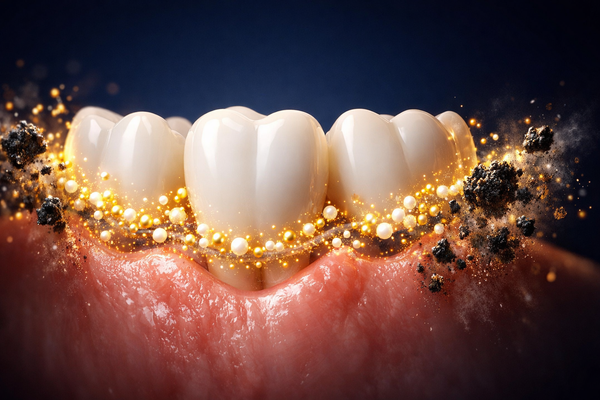
That matters because plaque does not need a dramatic amount of time to become irritating. When it stays undisturbed, the bacterial environment shifts, the gum responds, and small signs begin to appear: bleeding when brushing, a slightly puffy gumline, tenderness when flossing, or a metallic taste after cleaning.
The tightest spaces are often the least cleaned
The areas people miss most are often the exact areas where inflammation first becomes visible. That is why “I brush twice a day” is not always the same thing as “my gums are being cleaned properly.”
Gums react before you notice deeper damage
Bleeding is a surface signal. It shows up early, before many people think anything is wrong. That gives you a chance to intervene while the condition is still easier to reverse.

The Mistake Most People Make After They See Blood
Once bleeding starts, people often react in one of two unhelpful ways. They either avoid the area because it feels sore, or they attack it too aggressively because they assume more pressure means more cleanliness. Both responses can keep the cycle alive.
- Avoiding the area leaves the underlying plaque undisturbed and gives inflammation more time to continue.
- Scrubbing harder can irritate already inflamed tissue without solving the real cleaning gap.
- Only brushing visible surfaces makes the mouth look clean while the interdental problem remains.
- Cleaning inconsistently prevents the tissue from ever getting enough calm time to recover.
- Assuming munvatten is enough skips the mechanical disruption that plaque actually requires.
The better response is not panic and not avoidance. It is more precise cleaning with less violence: reach the margins, reach between the teeth, and do it consistently enough that the tissue finally gets a chance to calm down.
What Actually Helps: Disrupt, Flush, Calm
If bleeding starts where plaque sits longest, then the logic of the solution becomes simple. You need to disrupt the plaque mechanically, especially in interdental spaces, and you need to do it in a way that is effective enough to clean the margin without turning the routine into trauma.
This is where the space between teeth becomes the deciding factor. A brushing-only routine can leave those areas under-served. Interdental tools, including floss, interdental brushes, or a precise water-floss routine, are valuable because they help address what the toothbrush consistently misses.

Gum health improves when the routine stops pretending the visible surface is the whole story. A smarter protocol treats the mouth as a set of margins and contact points — not just a row of flat fronts.
The aim is not to “blast” the gums. The aim is to reduce the bacterial load where inflammation begins, so the tissue can stop reacting every time you clean it. In other words: less residue, less inflammation, less bleeding.
A Better Daily Routine for Bleeding Gums
Most people do not need a more dramatic routine. They need a more complete one. Gum health usually improves when the routine gets more targeted, more consistent, and less rough.
Clean between teeth before you brush
Start with the areas where plaque is hardest to remove. That means floss, interdental brushes, or a precise water-floss step before brushing the visible surfaces.
Use gentle pressure, not hesitation
Inflamed gums can bleed even when you are doing the right thing. The answer is not to stop cleaning. It is to clean thoroughly but gently enough that the tissue is not being scraped.
Brush the gum margin, not just the tooth face
The line where tooth and gum meet matters. That margin is where biofilm likes to sit and where people often rush through without realizing it.
Give it enough consistency to change
Gums do not become healthier from one perfect session. They improve when the same high-risk areas are cleaned properly day after day, long enough for inflammation to settle.
What Bleeding Gums Are Really Telling You
Bleeding is not just an annoying side effect of brushing. It is feedback. It tells you that something near the gumline is staying behind too often, too long, or too consistently. And because that usually starts in the spaces you cannot see clearly, it is also a reminder that visible cleanliness is not the same as real cleanliness.
That is the opportunity. When you respond early — before swelling becomes chronic, before pockets deepen, before the condition becomes harder to reverse — the routine does not need to become extreme. It just needs to become smarter.

The space between the teeth changes everything.
A better gum routine is not louder. It is more precise. Clean the hidden margins, reduce the inflammatory load, and give the tissue a reason to stop bleeding.
Explore the CALQIX ProtocolIf your gums keep bleeding, feel swollen, or seem to be receding, get them checked professionally. This article is about early-stage everyday gum inflammation — not a diagnosis for advanced periodontal disease.